2011年12月17日 星期六

National Fonghuanggu Bird Park

About the Bird Park
  The National Fonghuanggu Bird Park is situated at the foot of the mountain Fonghuang in Lugu, Nantou County . Located at an altitude of 650-850 meters above sea level, the park covers an area of 32 hectares. It is an ecological park for leisure and education, exhibiting numerous native and exotic birds. In recent years, the management has placed special emphasis on the conservation of endemic species. The Park also features a crane museum ( Songher Museum ), the only one of its kind in Taiwan . The surrounding area is home to innumerable species of wild birds, insects and reptiles. The nearby mountains get dressed in outfits of different colors as the seasons change. The vegetation along the paths offers visual delight to the visitors. The sudden appearance of fog and clouds due to the changes in terrain will present even bigger surprises. Visitors can either follow the touring instructions and enjoyBird Park  logowatching al kinds of birds, animals and plants or can simply sit back, take a deep breath, enjoy the view and let the fresh air massage their lungs and the tender fog caress their faces. Either as a half-day or a one-day trip, the Fonghuanggu Bird Park can be a great choice


Aowanda National Forest Recreation Area


Aowanda National Forest Recreation Area is situated in Renai Township, Nantou County at an altitude around 1000 meters to 2600 meters, occupying an area about 2700 hectares. Aowanda National Forest Recreation Area is famed for its natural resources, as well as the beautiful maple trees which attract large number of visitors every year. Featuring abundant maple trees and sites, the recreation area is the most popular maple tree viewing spot in Taiwan, earning the name Home for Maple Trees. 

Covering a large area, visitors may find a diverse of natural sceneries. The recreation area has been planned in various sections including waterfall zone, forest park, maple area and pine tree site. 
The waterfall zone has three waterfalls in different appearances due to the unique landscape. Visitors may walk along the one-kilometer-long forest path in the waterfall zone to breathe in phytoncide and appreciate the anions offered by the waterfalls. 

Yushan National Park


Yushan will be closed from January 31st till March 6th, 2010.
Yishan (Jade Mountain) National Park is the second national park in Taiwan. Covering an expanse of some 105,490 hectares, this is the biggest national park by area in Taiwan. East of the park is the Taitung Valley and Taitung Coastal Mountain Range. The west flank is the Alishan Mountain Range, where as the south flank consists of the s landscape is made-up of highlands, rivers and valleys. There are more than 30 mountains of altitude 3,000 meters or higher. 
These include Yishan's main peak, Shiuku Mountain, Tafenchian Mountain and Mapolas Mountain. These mountain ranges are picturesque and majestic. Visitors will be enchanted by views of snow capped mountains, seas of clouds and highland colorful clouds etc.
South Cross-island Road
and Kuanshan. The north flank is Tungpu Village and Zhintashan. The park area crosses Nantou, Chiayi, Hualien and Kaohsiung County.Yishan National Park


Link:http://tourguide.travelking.com.tw/eng/scenery228.html

Lushan Hot Spring


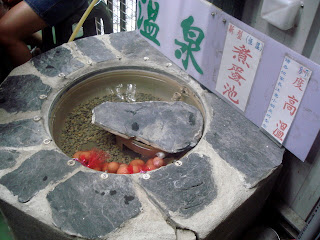
The Lushan Hot Springs is located in Nantou Countys Renai Township, one of the largest hot springs in Taiwan that provides alkaline carbonic acid base springs. It is also the highest hot springs in Taiwan with an altitude of 400 kilometers. The bi-carbonate springs in Lushan are clear and high in temperature, measuring 75-90 degrees celsius of water can easily boil an egg or noodles. With the pH content ranges from eight to ten, drinking the spring water is said to regulate ones acidity and cure chronic gastritis. The Lushan hot springs was also named the Cherry Hot Springs by the Japanese people back in the Japanese ruling period as Cherry trees surrounded by the hot springs offers cherry blossom views while they were bathing. 


Link:http://tourguide.travelking.com.tw/eng/scenery83.html

Sun Moon Lake Scenic Area


 The Sun Moon Lake is the largest lake in Taiwan and one of the most beautiful and most famous tour sites in Asia. Shaped like an irregular rhombus, the eastern part of the Sun Moon Lake is shaped like a round sun while the western part is like a crescent moon. Thus it was named Sun Moon Lake. The beauty of the Sun Moon Lake is the calm, turquoise water complemented by the majestic mountains that surround the lake. Layers and layers of mountains and countless mountain peaks can be seen as more distant mountains fade into the sky. Like a mystical Chinese painting, the scenery of the Sun Moon Lake is truly breathtaking.

There is an island at the middle of the lake, named Lalu. Lalu Island was a sacred place among the Thao tribe who originally inhabited there. The island used to separate the Sun Lake and the Moon Lake. However, due to the earthquake of September 21, 1999 and a number of historical events and constructions, the Lalu Island is much smaller than it was before. 

There are a total of 7 hiking trails in the surrounding mountains that provide different views and angles of the beautiful scenery at Sun Moon Lake. In addition, although swimming at the Sun Moon Lake is usually prohibited, there is an annual swimming carnival held at the Sun Moon Lake around the Mid-Autumn festival. 

Formosan Aboriginal Cultural Village


  Located in Talin Village, Yizhi (Fish Pond) Town, this renowned cultural village was opened in July 1986 and has since became one of the most renowned amusement parks in Taiwan. Over an expanse of some 62 hectares land, adjacent to the world renowned Sun Moon Lake, this park offers a variety of activities either it be for sightseeing, vacationing, cultural exchange, recreation or educational purposes.
The village is divided into four broad sections. The first is more for sightseeing where gardens, palace and European style castles rein the area. The second section consists of scientific displays where visitors can appreciate the laser bean display and the rhythmic movements of the musical fountain. The third section is the Future World Area, which houses a space theater and other fun rides such as Galaxy Ride, World Compound and Space Mountain etc. 


Link: http://tourguide.travelking.com.tw/scenery45.html

Puli Winery


Located in Puli Township of Nantou County, the Puli Winery is home to one of the eight national wines in Taiwan, the Shaosing Rice Wine. As implied by its name, it was originally produced in Shaosing, in China’s Zhejiang province. Where it was made and fermented from high-quality sticky rice, barley and distilled water. And since Puli offers warm weather and sweet, clear water, the Puli Winery has come to be known for producing excellent quality of Shaosing Rice Wine with bright yellow texture and unique fragrance. 

The winery uses its own improved method of making the wine, sealed tightly and stored in earthen jar for 30 months, and for some higher-quality Shaosing Rice Wine, at least 60 months are waited for storage. Since the strict quality control and the fine water from Ailan springs, the wine produced here are superior quality with long-lasting taste.

   opening hours:

Monday to Friday08:30 A.M. ~ 17:00 P.M.
Weekend
08:30 A.M. ~ 17:30 P.M.


By Car:
(From North) Freeway 1
Exit at the Taichung Port (Zhonggang) Interchange Provincial Highway 74 (Taichung- Changhua Expressway) Provincial Highway 14 Caotun Puli.

(From South) Freeway 3
Exit at the Caotun Interchange Provincial Highway 14 Caotun Puli.

By Bus:
1. Take Guoguang (Kuokuang) Bus from Taipei West Station to Puli.
2. Take Nantou Bus from Taichung Station to Puli.
3. Take Fenglong Bus from Shueili to Puli.